Guest Author
February 23, 2005
Only one year after Vladimir Putin handily won a second presidential term, his domestic and foreign challenges are snowballing and his aura of almost superhuman invincibility is quickly dissipating. This is not to say, however, that Putin should be counted out: He is still in control. The question is: for how much longer?
Under Putin, Russia is pursuing uneven, unpredictable, and counterproductive policies in its self-declared-and shrinking-sphere of influence, nicknamed the "near abroad." The Russian foreign policy and defense establishment seems unable to design and implement policies that would further develop cooperation with NATO or fight Islamist (Salafi/Wahhabi) terrorism in the Northern Caucasus. Meanwhile, hard-line circles are assailing the Putin Administration for failing to secure the election of pro-Russian politicians in Ukraine despite vast expenditures to do so.
Further, the Kremlin failed to control, let alone reverse, ubiquitous corruption in the state apparatus. The Russian state has not become a reliable and civilized partner to domestic and foreign business-which would have provided the rule of law, predictable legislation and regulation, and property rights and investor rights that are not subject to political whims.
Read more...






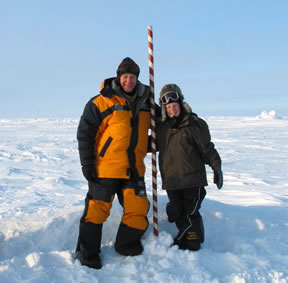 My youngest son Jackson and I will be making a trip to the North Pole this month. I started leading expeditions to the North Pole in 1978. This will be my 21st time to 90 North, the apex of the world. It will be Jackson’s 3rd. He’s 10 years old.