



 The Collapse of Russia’s Sacellum
There’s smoke rising in the Vatican, and it’s not from frankincense. It is the signal flare of a geopolitical shift. Pope Leo III’s inauguration, wrapped in Eastern rites and Greek chants, was a direct challenge to Russia’s spiritual monopoly. The Vatican isn’t reaching across the aisle—it’s drawing a blade. By deploying the Filioque-neutral Augustinian tradition, Rome is constructing a theological bridge to Constantinople, creating the conditions for a historic reunification of Eastern and Western Christianity. If a Vatican III comes, it will dismantle Moscow’s global claim to Orthodox leadership.
Russia, meanwhile, is no longer a player—it is the battlefield. The Ukraine invasion was a strategic misfire that backfired spectacularly. NATO stiffened. Ukraine became a tech-driven kill zone. Sanctions cracked the fossil economy. Tensions simmer in Tatarstan and the Caucasus. Moscow’s church-state fusion, once a pillar of national unity, is now a fault line of ethnic and sectarian unrest.
Moscow thought it could sacralize its power through Orthodoxy. Instead, it has bound itself to a Church now under Vatican pressure. Patriarch Kirill is a Kremlin mouthpiece in robes, and the Orthodox world is splintering. The Ecumenical Patriarchate already broke ranks. Rome is playing for centuries; Russia is bleeding years.
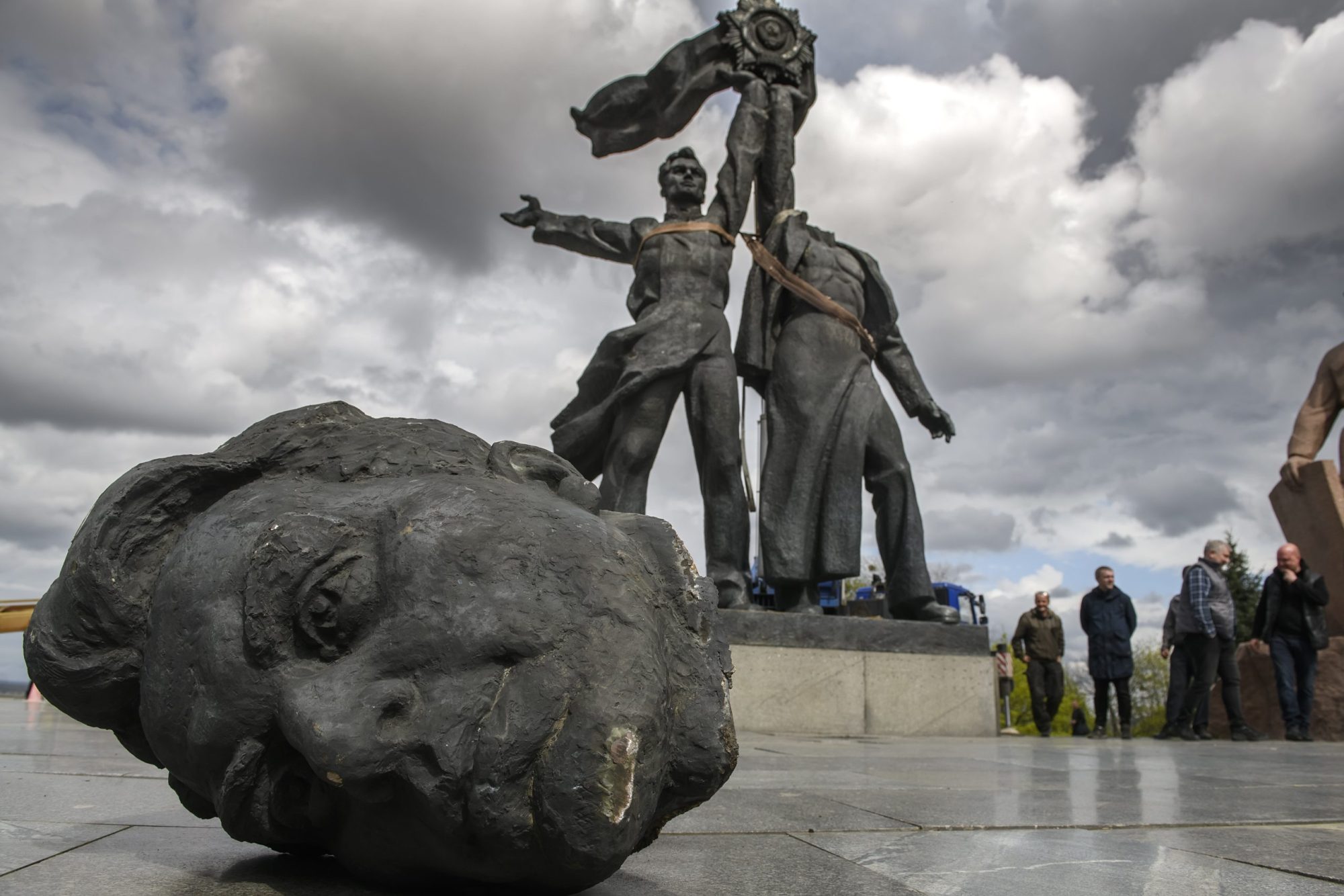
The sacellum, or the sacred heart of civilization, always falls first. Russia’s is crumbling. America’s flickered dimly under Biden but now grows brighter. China’s, wounded but still standing, is watching. This isn’t about incense and vestments. It’s about civilizational control. The altar is now the battlefield and the very pillars of legitimacy beneath the Russian state are giving a metaphysical shrug.
To The Point publishes this historic speech by President Reagan on each Memorial Day. r.
 September 19, 1827- near Natchez, Mississippi.
It was a time where personal honor was worth more than life, and slights to it could be deadly.
Several men came to a sandbar in the Mississippi River as a result of such a slight—for a duel, where two aggrieved men would settle their differences with violence—in this case, with black powder pistols. The main contestants had “seconds,” who were essentially referees for the duel. One of those seconds this day was a Kentucky-born and Louisiana-raised slave trader, land speculator, businessman, farmer, adventurer, and international man of mystery named James Bowie.
What would happen on this date would change how the new Americans fought and would give the new nation one of its first, and iconic, weapons.
 This week, the Supreme Court continued to deliberate over what to do with the growing number of national or universal injunctions issued by federal district courts against the Trump Administration.
The court has long failed to address the problem, and what I call “chronic injunctivitis” is now raging across the court system.
Justices have only worsened the condition with conflicting and at times incomprehensible opinions.
Both Democratic and Republican presidents have long argued that federal judges are out of control in issuing national injunctions that freeze the entire executive branch for years on a given policy.
For presidents, you have to effectively sweep the district courts 677-to-0 if you want to be able to carry out controversial measures.
Any one judge can halt the entire government.
Under President Barack Obama, Justice Elena Kagan expressed outrage over the injunctions in public comments at Northwestern University School of Law.
Kagan lashed out at the obvious “forum shopping” by then conservative advocates to get before favorable courts, insisting “It just cannot be right that one district judge can stop a nationwide policy in its tracks and leave it stopped for the years it takes to go through the normal [appellate] process.”
In his first term, Trump faced a more than 450 percent increase in the number of such injunctions over the number issued under Obama — a rise from 12 to 64.
The number then went down to just 14 under former President Joe Biden.
With Trump back in office, district courts have now outstripped that record and may surpass the total from the first term in the first year.
 The antidote to war is not peace.
The antidote to war is commerce.
This concept of cultivating peace by fostering commerce traces its roots back to Montesquieu and the Enlightenment.
The thought is that increasing commerce leads to shared interests, recognition of the rule of law, and growing prosperity, all of which preclude armed conflict.
At the end of WWII, the U.S. realized that only America, with about fifty percent of the global GDP, could reignite the fires of international trade, production, and competition.
In league with its wartime allies, agreements like Bretton Woods were executed and multilateral regulatory and monitoring organizations like the WTO were established.
With its enormous financial, military, and market clout, America was able to get the flywheel of global commerce moving again.
It worked, of course.
In 1945, global GDP was approximately $1T, while today it is about $117T.
Even better, the percent of the world’s population living in extreme poverty shrank from fifty-five percent to less than ten percent today.
These epic improvements are all due to the expansion of global commerce and free markets, driven by the U.S. sharing its markets, finances, and enforcement power.
But we still have war….it’s obvious to the casual observer that the outstanding component of the Trump Administration’s foreign policy is increasing commerce…
 On May 9, 2024, a fire broke out at an IKEA warehouse in Vilnius, Lithuania (Lrytas, May 20, 2024). Subsequent investigations revealed that the arson was orchestrated by Russia’s military intelligence agency, the Main Directorate of the General Staff of the Russian Armed Forces (GRU), and that the suspects were also planning similar attacks in Latvia (LRT, March 17).
The Lithuanian Prosecutor General’s Office classified the incident as an act of terrorism aimed at intimidating the societies of Lithuania and pressuring them to reduce support for Ukraine (LRT, March 17).
Russia’s hybrid warfare strategy extends beyond its war against Ukraine as it also targets other European frontline states through influence operations, election interference, and intimidation.
The Baltic States—Estonia, Latvia, and Lithuania—are targeted by Russian hybrid tactics as a daily reality and direct challenge to their sovereignty.
Historically, Moscow has used political, economic, energy, and cyber tactics to undermine the Baltics.
Recent efforts, however, are markedly more aggressive, particularly as they involve military pressure.
Understanding the origins of Russia’s hybrid strategy is crucial to recognizing its evolving influence in the region.
 Make no mistake about it: The Democratic Party is facing an existential crisis that even their media allies can't spin anymore.
The New York Times, the crown jewel of the liberal media establishment, just published a devastating analysis showing how the Democrats' supposed stronghold on American politics has crumbled under the MAGA movement.
While Democrats continue their tired routine of Trump-bashing and pretending to care about working Americans, the numbers tell a completely different story.
The Times' analysis reveals a political earthquake that's reshaping the electoral landscape, and it's not in the Democrats' favor.
“All told, Mr. Trump has increased the Republican Party's share of the presidential vote in each election he's been on the ballot in close to half the counties in America — 1,433 in all. It is a staggering political achievement, especially considering that Mr. Trump was defeated in the second of those three races, in 2020. By contrast, Democrats have steadily expanded their vote share in those three elections in only 57 of the nation’s 3,100-plus counties.”
In the 2024 election, six times as many counties shifted toward the GOP as toward the Democrats. While 435 counties trended more Democratic compared to 2012, 2,678 moved more Republican—by an even larger average margin of 13.3 points versus 8.8 for Democrats.That's not just a loss; that's a political bloodbath.
 A new rapid blood test for newborns could potentially detect genetic mutations linked to thousands of rare diseases all at once, greatly improving on current inefficient detection methods, according to a study to be presented Monday.
The new test developed by Australian scientists has proven highly accurate in identifying gene mutations associated with many rare, inherited diseases, all from just a minimally invasive blood sample taken from infants and children, the authors say.
The study, being unveiled at the European Human Genetics Conference in Milan, Italy, demonstrated that a single, untargeted test capable of analyzing 8,000 human proteins at once was able to correctly identify 83% of people with confirmed rare, inherited diseases.
The "proteomics" test was also able to differentiate between parental carriers of the mutations, who only have one copy of the defective gene, and the affected child, who carries two copies.
Those encouraging results are raising hopes for a new era in which screening infants and children for suspected inherited rare diseases can be accomplished quickly and efficiently for the first time, and that testing can be extended to many more of the estimated 300 million people worldwide affected by these genetic mutations.
Testing for suspected inherited diseases has traditionally been a time-consuming, costly and sometimes painful process that required different procedures for different suspected mutations. But that paradigm could be about to change, the study's lead author says.
Daniella Hock, a senior postdoctoral researcher at the University of Melbourne, told UPI that if the test is implemented in clinical labs, "it can potentially replace multiple functional tests. This can potentially reduce the diagnostic time for patients and families and healthcare costs.
"The test only requires only 1 milliliter of blood from infants, and results can be achieved in less than three days for urgent cases," she said.
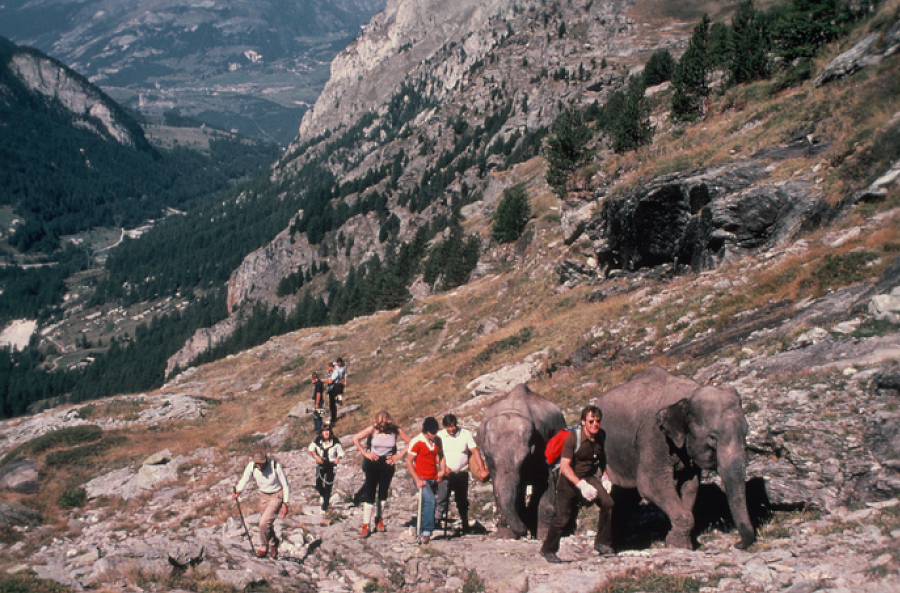 September 1979 – my Hannibal Expedition took two elephants over the same pass Hannibal used in 218 BC across the Alps to attack Rome. There is only one pass that fits the contemporary descriptions of both Greek historian Polybius and Roman historian Livy: The Col du Clapier on what is now the French-Italian border.
Unrecognized as Hannibal’s Pass in 1979, it is still a roadless trail today crossed only on foot or mountain bike. But since our expedition, there are now signs proclaiming it La Route d’Hannibal, and even a life-size statue of an elephant at the French village of Bramans where the track over the pass begins.
The photo you see is us climbing high above Bramans (I’m the one in front with the red backpack). It took us five days to carefully guide our elephants (from an Italian circus) over Clapier and down to the Italian village of Susa. First time in 2,197 years and never repeated 41 years since.
Hannibal’s crossing the Alps with elephants is one of the most epic events of world history. To retrace it yourself with elephants is to make that famous history a part of your life in the most uniquely powerful way. (Glimpses of Our Breathtaking World #15 photo ©Jack Wheeler)
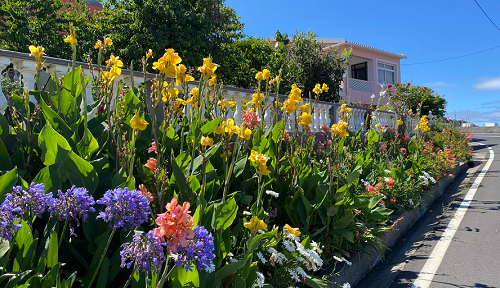
Funchal, Madeira. On the Portuguese island of Madeira in the Atlantic Ocean, there is a common expression: “A home without flowers is like a naked person without clothes.” Here is an example, one of many thousands. The Portuguese explorers discovered Madeira in 1419. It was uninhabited at the time and always had been, no human being had ever been there before. Over the seven centuries since, an enormous variety of plants from all over the world were brought here and flourished in the eternal spring weather and volcanic soil. Every fruit, vegetable, tree, bush, flower easily grows here, a botanist’s paradise. And a paradise for the people who live here, who love to beautify their homes and towns with gorgeous gardens everywhere. Come with Rebel and me to see for yourself. (Glimpses of Our Breathtaking World #298, photo ©Jack Wheeler)
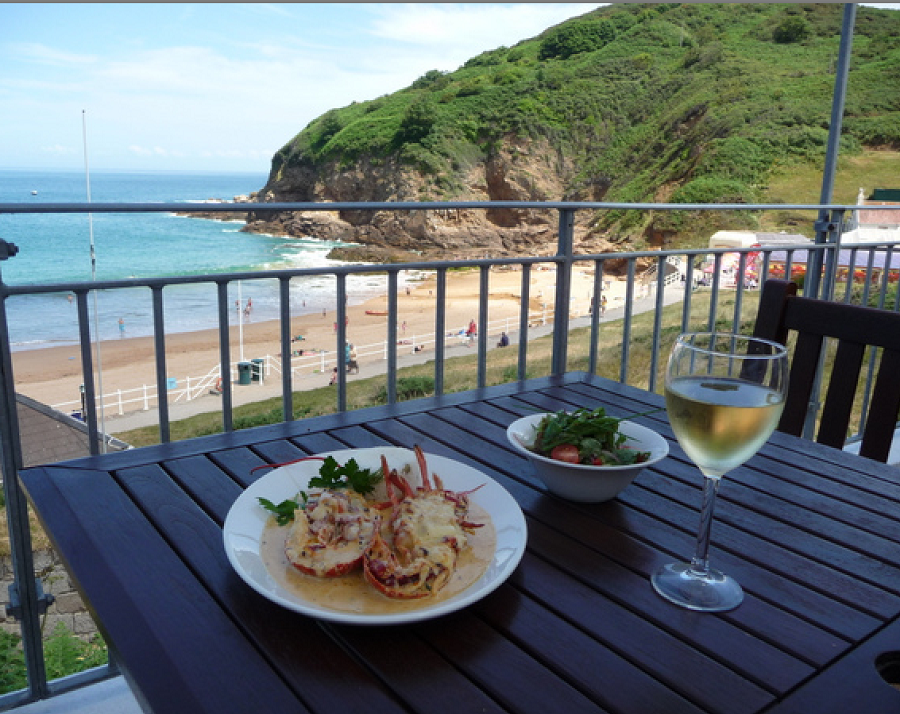 Belvoir Beach, Herm, Channel Islands. Could there be a more idyllic lunch—grilled lobster, fresh garden salad, chilled Chardonnay – here on Herm, the smallest of the five main Channel Islands. There’s Jersey, Guernsey, Sark, Alderney – and tiny Herm. Less than one square mile, but overflowing with charm and hospitality – from the Victorian White House Hotel to the Mermaid Pub to lobsters at Belvoir Beach. Coming here is a true escape from the worries of the world. At Herm they are a long ways away. Glimpses of Our Breathtaking World #177 photo ©Jack Wheeler)
 Nagas are multi-headed dragons who rise up to protect the former royal capital of Laos, Luang Prabang. The city along the Mekong River has been the center of Lao culture since the 600s. The Kingdom of Laos, “Land of a Million Elephants,” had to struggle for centuries to avoid being absorbed by the empires of Siam and Khmer (Cambodia). It was the French who wrested Laos from Siam (Thailand) in the 1890s, giving it independence in 1953.
For centuries, devout Buddhists have been building beautifully ornate shrines and temples called Wats here in Luang Prabang. Every day at dawn, hundreds of red-robed monks living in the Wats parade through the city streets for donations. Since the Pathet Lao seizure of power in 1975, moving the capital to Vientiane, Luang Prabang is free of politics, preserved as a religious haven and treasure house of Laotian culture.
A few days here is not to be missed. As you enjoy a glass of good French wine at a riverbank café watching the sunset over the Mekong, give thanks to the Nagas who are still protecting this sanctuary city. (Glimpses of Our Breathtaking World #24, photo ©Jack Wheeler)
 My skydiving buddy Chris Wentzel and I made this flag jump on Memorial Day years ago to pay tribute to those in our military who gave their lives for America. I’m on the right, Chris on the left. The jump was performed at the Skydive Perris drop zone in Perris, California. It’s only fitting I post this on TTP in honor of those whom we memorialize in gratitude on this Memorial Day weekend. (Glimpses of Our Breathtaking World #303 photo ©Jack Wheeler)