



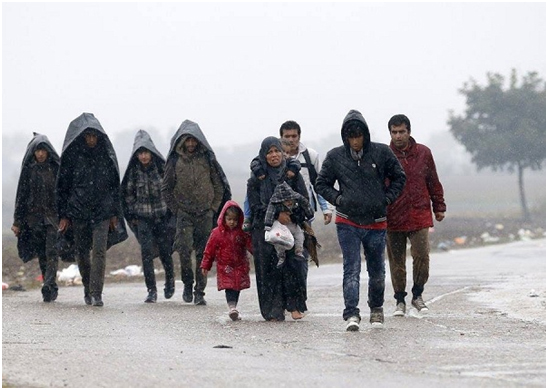
 What do you see here? A group of Moslem “refugees” walking in a snowstorm headed for the German Welfare State?
Well, yes – but look more closely. There are seven men and one woman – and the woman, unlike the men, is barefoot. What’s more, she is carrying two children – and not one of these seven men is lifting a finger to help her.
This encapsulates the incapacity of a culture that looks upon and treats women as sub-human to adapt to the moral norms of Western Christian Civilization.
That Europe would allow people in the millions from such a culture to flood their shores is suicidal. The horror of Brussels on Tuesday (3/22) should not come as any surprise in the slightest. This is what being suicidal begets – you become prey for the predators.
This is a teachable moment. It is prime time to learn – or relearn as TTP has been teaching this for years – the root cause of the West’s and America’s suicidal inability to defend itself from foreign threats, be they Moslem terrorism, tsunamis of illegal immigration, or an America-hating president.
In May of 1989, I had a cup of coffee with a young man in a café in Nickelsdorf, Austria.
In his mid-twenties, he had crossed an unguarded section of the border with Hungary just two hundred yards away to meet me. There was mud on his shoes from the fields he had crossed.
He was a founder of an Anti-Communist freedom movement in Budapest called Fidesz (the Hungarian acronym for Alliance of Young Democrats). Since 1983, I had made it my business to meet people such as him.
For six years, I had been spending time with armed guerrilla movements fighting wars of liberation within Soviet Third World colonies – in Afghanistan, Nicaragua, Angola, Mozambique and elsewhere. Now, with Soviets defeated in Afghanistan (February 1989), it was time to focus on the new democracy movements in Eastern Europe.
The young man explained in halting English what Fidesz stood for and what they wanted to accomplish – liberation from Soviet tyranny by peaceful means, real democracy with all the freedoms considered normal in the West, to rejoin Western Civilization again.
The more I listened, the more he answered my questions clearly and without guile, the more I was impressed. He was serious, committed, and very smart. I made my decision.
Yesterday and today (3/21-22) are sad days in American history. For decades, leftists and Hollywood liberals have made the pilgrimage to Cuba to pay homage to Fidel Castro and Raul Castro. It’s very chic, it’s very shi-shi, for leftists to celebrate vicious communist dictators.
Communist Havana has always been a magnet for the radical chic of the left, drawn like moths to the flame of this western outpost of totalitarian Communism. Back in the 1960s, the visitors included Angela Davis and Stokely Carmichael, while Che Guevara himself received Jean-Paul Sartre. Today, the President of the United States joined them.
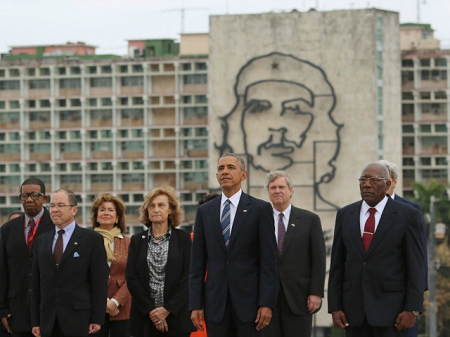
I have this to say to Mr. Obama: You, the President of the United States, have now legitimized the corrupt and ignored the oppressed. What’s American about that? Nothing.
I have this to say to the people of Cuba who are witnessing this gaudy spectacle in Havana: America has not forgotten you. When I am president, I will never forget you.
America needs something better than a feedback loop for popular resentment. We need a real leader.
America's elite is arrogant and corrupt, but the state of the American people is just as alarming. America had 90% adult literacy in 1790, when only half of Englishmen and a fifth of Spaniards and Italians could sign their names. We had the best educated, most motivated, and healthiest workforce in the world by an overwhelming margin.
Now Americans aged 16 to 24 rank at the bottom of a 22-country evaluation of numeracy, literacy, and technological problem-solving.
Poor student performance should be no surprise: America's family structure is falling apart. Nearly 30% of non-Hispanic white children are born out of wedlock, as well as 53% of Hispanics and 73% of African-Americans. When Reagan took office, 18% of all American births were to unmarried mothers. By 2014 the figure was above 40%.
Catch-up ball doesn't begin to describe our predicament. We need nothing short of a great national turnaround. There are two Republican candidates who made clear from the outset that it isn't business as usual -- Ted Cruz and Donald Trump. Another Romney wouldn't be relevant.
I first became aware of Donald Trump when he chose to make cheating on his first wife front-page news.
It was the early '90s. Donald and Ivana Trump broke up over the course of months. Not that divorce is shocking, mind you; among the glitterati marriage seems more unusual. Nor is infidelity exactly novel.
But it requires a particular breed of lowlife to advertise the sexual superiority of one's mistress over the mother of one's children. That was Trump's style. He leaked stories to the New York tabloids about Ivana's breast implants -- they didn't feel right. Marla Maples, by contrast, suited him better.
She, proving her suitability for the man she was eager to steal from his family, told the papers that her encounters with the mogul were "the best sex I've ever had." It wasn't just Donald Trump's betrayal that caught my eye, nor just the tawdriness: It was the cruelty.
Interest rates in the United States have fallen to minus 2% in real terms and are dropping into deeper negative territory with each passing month. This is a remarkable state of affairs.
It is clear that the US Federal Reserve is now trapped. The FOMC dares not tighten despite core inflation reaching 2.3% because it is so worried about tantrums in financial markets and about that other Sword of Damocles - some $11 trillion of offshore debt denominated in dollars, up from $2 trillion in 2000.
The Fed has been forced by circumstances to act as the world's central bank, nursing a fragile and treacherous financial system struggling with unprecedented leverage.
Average debt ratios are 36 percentage points of GDP higher than they were at the top of the pre-Lehman bubble in 2008, and this time emerging markets have been drawn into the quagmire as well by the spill-over effects of quantitative easing. Like it or not, the Fed is stuck with the task of cleaning up a global mess that is arguably of its own making.
The three big blocs of the world economy are all in a short-term cyclical upswing. My fear is that the Fed may have repeated the error made by Alan Greenspan during the East Asia crisis of 1998 when he slashed rates and held them too low for too long, fueling the dotcom bubble.
Berlin, Germany. Even though the Berlin Wall was destroyed more than a quarter-century ago and the city rebuilt, new propaganda wars are being waged here and elsewhere by the major and some minor powers in a more sophisticated way than the Soviets ever imagined.
Disinformation has always been a staple of states and spies, but now the world’s airways are being swamped with state-controlled TV “news” stations. Of the 83 TV channels I have access to in my hotel room, roughly 32 of the 51 non-German channels are largely owned or controlled by various governments.
This includes the Russian, Chinese, Qatar (Al Jazeera), Thai, Vietnamese, Armenian, Turkish, and Cuban governments. The Russian, Chinese, Qatar, Japanese and French governments have full-time English-language channels here in Berlin, clearly designed to reach an audience outside of their home-country nationals who may be living in or visiting Berlin.
These are almost entirely commercial-free channels, paid for by the taxpayers of their respective countries, and are now found in most major cities in the world, at some considerable cost. The question is: Why are they doing it?
A lot of people believe that human nature is evolving and changing in some significant manner. This comes in part from a social psychological notion that culture can change human nature, and that different cultures therefore create, to a significant degree, different people.
If human nature were indeed so malleable, then it could be argued that we can evolve that nature into something different. But human nature is not that malleable. Human nature is pretty much what it was thousands of years ago.
Even so, we are certainly in a better condition, particularly in the West, than our more primitive ancestors. So what is it, exactly, that is changing and evolving in us that leads to such improvement?
Human culture: the understandings, innovations, and meaning that we are able to teach to others, and pass down through the generations.
So -- what are the common features of successful human culture? Knowing this would place us on the true path of human evolution.
On Wednesday (3/16), Megyn Kelly interviewed Ted Cruz.

At 4:25 Cruz explains why Trump is the one candidate Hillary can beat. At 7:30 he explains how he’ll get a majority of delegates and avoid a contested convention.
But in case there is, here’s a neutral solution for avoiding it. Plus a slew of convincing reasons (beyond Cruz’s) why Trump has no chance of beating the PIAPS in November.
We have to get out of here, however, so we see what’s happening with Putin, and bad news in China. The Hero of the Week will surprise you, yet you may cheer nonetheless.
The paradox of the individualistic society is that it can only exist if individuals embrace virtues that are greater than their own needs and whims.
A society where each individual acts as a little tyrant, pursuing his desires with total selfishness at the expense of everyone else becomes collectivist as the little tyrants turn to a series of big tyrants to get what they want no matter who gets hurt by it.
As individual virtues and social compacts break down, selfish squabbles escalate. Tribalism turns into legal civil war. Laws become the means by which one group imposes its will on the other and by which one man seizes the property of another. The people come to view the system with contempt. All virtues and principles are abandoned as neighbor turns on neighbor in resentment and hatred.
Ideas can exist objectively. Feelings only exist subjectively. Identity politics resolves this problem by treating the objective response to feelings as privilege. But even subjective empathy can never truly approach the subjective experience of the crybully.
Even a member of that same identity group will differ in some way from the multiple intersectional identities of the crybully. And that difference is its own privilege. This isn't really politics. It's self-help narcissism crossbred with stale Marxism.
It is seldom that the fate of a nation can be traced to what happened on one particular day. But that may be what happens in the United States of America today, Tuesday, March 15, 2016.
That is because the front-runners in both political parties are not merely inadequate but appalling -- and the vote in today’s primaries in Florida, Ohio, Illinois, Missouri, and North Carolina may be the last chance for the voters to unite behind someone else.
The trends that brought us to this crucial day go back for years. But whatever the paths that led to this crossroads, we are in fact at a crossroads and our future, and our children's futures, depend on whether we can come up with some presidential candidate better than either Hillary Clinton or Donald Trump.
In other times and in other conditions, one bad president could not ruin a great nation. We survived Jimmy Carter and we may survive Barack Obama, but there is no guarantee that we can survive an unlimited amount of reckless decisions in a dangerous world.
Charismatic leaders like Trump who articulated the just grievances of the people have often risen to power on the basis of that talent alone. And those who put them in power have often paid a catastrophic price afterwards. That story was repeated in countries around the world in the 20th century.
Will that story be repeated in America in the 21st century? The vote today may give us a clue.
Donald Trump recently picked an interesting quote of Benito Mussolini’s to re-tweet on Twitter:
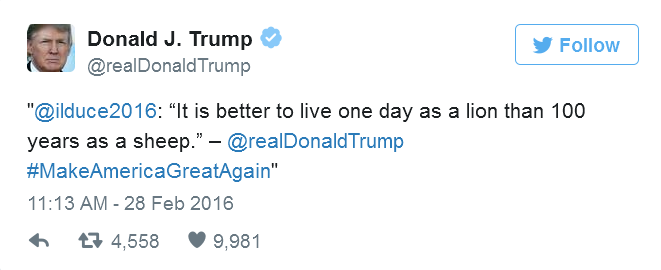 On one hand, I can understand the sentiment. I myself have often quoted Emiliano Zapata’s famous line “Better to die on your feet, than live on your knees” and it doesn’t necessarily mean I know much about Zapata (which I don’t), much less whether I would have agreed with him about much else.
Still, Trump’s use of “Ilduce2016” in his tweet hashtag caught my eye as somehow strange, almost a little too enthusiastic. So I found myself wondering, if Trump finds this historical figure inspiring, perhaps we should study the other teachings of the “Duce” to see whether there are other areas where their philosophies are similar.
Do you support free speech? How about free speech for climate change skeptics? For homophobes? For racists? For sexists? For white males? For even Donald Trump?
Those who defend free speech, as did the American Founding Fathers, understand it is not about defending speech you agree with, but defending speech you disagree with. Without free speech, there is no liberty.
The State Department diversity officer, John Robinson, has just warned the staff that they may be penalized for engaging in "microaggressions," which include jokes or other comments that someone who hears them may find offensive.
In a recent letter, he referred to a definition of microaggressions as "everyday verbal, nonverbal and environmental slights, snubs or insults, whether intentional or unintentional, which communicate hostile, derogatory or negative messages to target persons." In other words, whatever you hear may be considered a microaggression if you choose to be offended.
Such vague and infinitely elastic laws and regulations are the bread and butter of all totalitarian regimes.