







 [There has been much talk in recent days of slowing U.S. artificial intelligence research. China immediately announced that it would have no part of the “fearmongering” and would not slow down at all. But they are far from the only active enemy employing AI against us. — Rod Martin]
In 1999, two psychologists conducted a study in which test subjects counted how many times a basketball was passed among individuals wearing white shirts. The passing was not tricky to see. The action was not particularly fast. On its surface, it was a simple task.
Yet half of the participants missed the gorilla.
Midway through the video, a student in a full gorilla costume walked into the center of the court, turned to face the camera, thumped its chest, and strolled off-screen.
The viewers’ eyes swept over the primate. Still, their brains, entirely consumed by the mental arithmetic of pass-counting, filtered out the visual data.
They missed the obvious because they were preprogrammed to a particular task.
A decade later, researchers ran a similar experiment with board-certified radiologists. These were not novices, but bona fide experts, examining chest CT scans.
These doctors were asked to look for suspicious lung lesions, called nodules, often indicative of cancer. Special software tracked their eye movements so researchers would know exactly where they were looking.
But then, just as in 1999, there was a gorilla.
Embedded in the lung tissue of the final scan was a graphic of a gorilla, 48 times the size of the average cancerous nodule. Of the 24 radiologists in the study, 20, or 83 percent if you are so inclined, failed to see it, despite the eye-tracking software proving they had stared right at it for half a second.
How could they have missed a gorilla in a chest CT scan? When they stared directly at it?
This cognitive glitch, inattentional blindness, is not merely an academic curiosity. It is the ultimate cloak for asymmetric warfare.
When sophisticated transnational networks build advanced technical capabilities, they do not rely solely on physical camouflage. They construct operational decoys tailored to the predictable diagnostic schemas of state bureaucracies.
Flood the field with common crimes, and the big one gets through.
Send a flurry of small drug shipments to distract from the large one.
Give the state a low-level, familiar crime to count, and it will count it.
A bureaucracy will never look up, never see the oddity.
The Cartels Up Their Game
 Many civilians hold preconceived notions about criminals and their activities. Some are surprised to learn that criminals are not all bumbling, uneducated brutes, and that their ranks include highly intelligent businesspeople, scientists, and engineers.
Professionals carry this same burden. Preconceived notions abound.
For years, many experts felt confident that fentanyl would not be abused, simply because it was so potent and dangerous. More than 500,000 Americans have died from fentanyl-driven synthetic opioid overdoses since 2005.
Strange submarines were once dismissed as Bigfoot sightings, urban legend, and nothing more.
Then, in 1996, the United States Coast Guard captured an intact semisubmersible narcosub 100 miles off the coast of Costa Rica. It had a carbon-fiber hull, diesel-electric power, thermal-blocking, water-cooled exhausts, and satellite navigation.
A clandestine shipbuilding program was operating in the jungles of South America. The myth of the narcosub was shattered.
El Chapo’s communications network told a similar story.
What looked like disposable SIM cards and burner phones turned out, once an FBI-turned IT specialist gave up the details, to be a private VoIP network running on servers scattered across Canada and the Netherlands.
The network was complete with automated wiretap software, spyware for real-time GPS tracking, and counter-surveillance tools aimed at cartel rivals and Mexican state officials.
The Zetas were thought to rely on off-the-shelf walkie-talkies and pirate frequencies. They were actually running an air-gapped, military-grade multistate radio command network.
Even the small stuff got underestimated.
Los Viagras ran what looked like a low-grade Wi-Fi extortion racket in rural Michoacán, charging residents $25–$30 a month, a simple municipal shakedown worth $150,000 a month on paper. Then cyber-forensics specialists opened the seized routers and found firmware built for deep packet inspection, MAC address logging, and traffic redirection.
In other words, a signals intelligence network for monitoring police radios and triggering an internet kill-switch during military operations.
The submarine, the burner phones, the walkie-talkies, the Wi-Fi shakedown, all these “myths” were far more than anyone expected.
The preconceived notion dictated the charge, and the charge dictated the scope of the investigation.
If an anomaly fell outside the standard legal form, it simply did not exist. Figments of the imagination, until they could not be ignored.
A Server Farm in Cartel Country
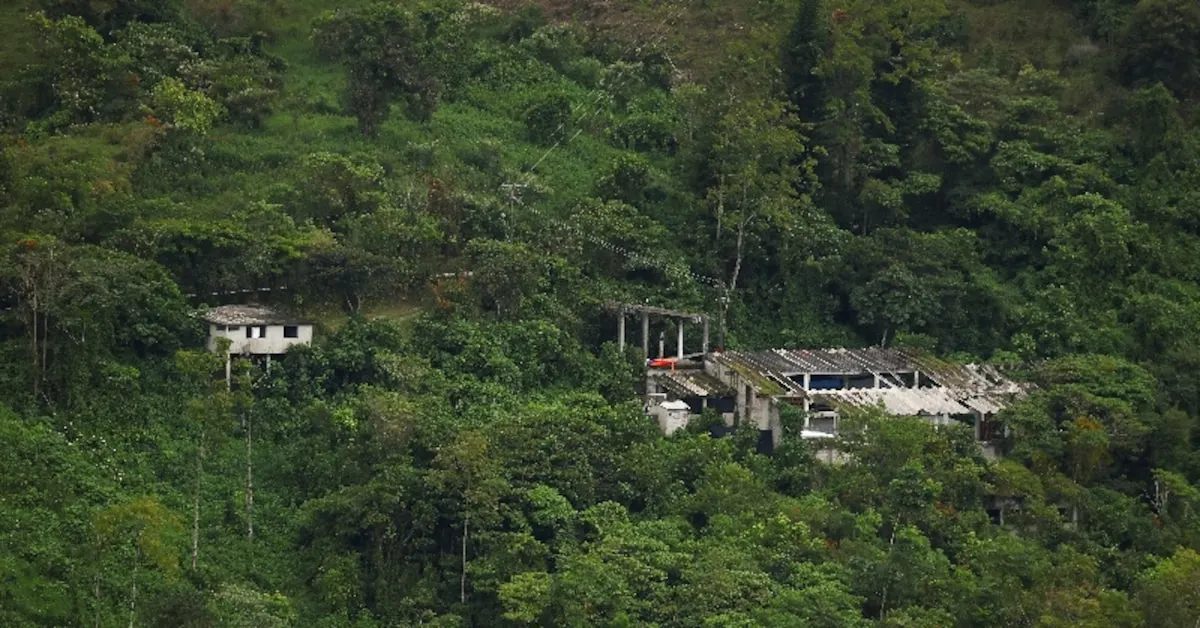 All of this brings us to a secluded mountain compound in Tlaola, Puebla: 100 miles northeast of Mexico City, 175 miles inland from the Gulf ports of Veracruz and Tampico, less than 500 miles from the U.S. border crossing at Brownsville, Texas.
Tlaola sits in the rugged, cloud-draped peaks of the Sierra Norte de Puebla, dense pine canopy and steep ravines, far removed from the technological hubs of Mexico City or Monterrey.
It is not ungoverned territory in any meaningful sense. Puebla’s own state security chief, Vice Admiral Francisco Sánchez González, has publicly acknowledged that the Jalisco New Generation Cartel (CJNG) operates active cells throughout the Sierra Norte, including La Barredora, a faction built around hydrocarbon and resource theft, which is the same underlying crime, applied to fossil fuel instead of electricity, that the state charged at Tlaola.
No public investigation has confirmed a direct CJNG link to this specific compound; officials have said only that the possibility is being examined.
But the region was never a blank spot on the map. It was already quasi-sovereign territory, governed day to day by an armed organization the state has openly admitted it does not fully control.
That makes it harder to credit the state’s surprise at finding sophisticated infrastructure there.
Peer beneath the canopy and the quiet rural exterior conceals a strategic advantage: proximity to the Necaxa hydroelectric system, Mexico’s oldest hydroelectric power network.
What was built beneath that canopy did not look like a technology hub, nor a traditional cartel stronghold. No concrete guard towers. No razor wire. No armed sentries on the access roads.
The inventory later logged a single shotgun and 12 shells of .410 caliber on-site, a small-game gun, the kind a groundskeeper keeps for varmints.
The overkill at this site ran entirely in one direction: a small fortune in surplus GPU capacity, guarded by a bird gun. To a passing farmer, the facility looked like an oversized, corrugated-metal agricultural shed, indistinguishable from hundreds of others dotting the countryside.
But the compound was not silent. Locals could hear its low mechanical hum through the tree line at all hours, machinery running far past what any storage shed required.
They said nothing. They had lived long enough in the Sierra Norte to know the fate of the squeaky wheel, so they heard, and they kept their mouths shut. The site got away with being loud because no one nearby was willing to be the one who noticed.
What finally drew the attention of authorities was not a counter-intelligence operation or a signals intelligence leak. It was routine utility usage data.
Technicians from the Federal Electricity Commission (CFE) conduct line audits along regional distribution networks. They noticed persistent voltage drops and abnormal thermal signatures from a medium-voltage circuit running through the mountains.
Millions of pesos worth of industrial-grade electricity were vanishing into the forest.
The state’s reaction was dictated by its diagnostic schema. Power missing is power theft.
When federal prosecutors, naval units, and utility inspectors organized a joint task force, they went in looking for huachicoleo de luz, industrial-scale power theft.
The naval component was not incidental. Mexico’s Marines (SEMAR) are widely regarded as the country’s least compromised federal force, the branch most often trusted with operations where corruption would be fatal to the mission.
Their presence signaled that someone, at some level, suspected this was more than a routine theft case, even if the paperwork never reflected it.
Their strategy was by the book. Locate the illegal line splice. Audit the unmetered draw. Log the theft. Proceed with the case just as they always had.
Given recent regional news, investigators expected a cryptocurrency mine stealing power to harvest digital tokens. It fit a pattern.
Before a single boot touched the mud, military drone overflights had already mapped the target, confirming what the voltage data implied. Thermal imaging registered massive heat plumes bleeding through the corrugated roof, the sort of signatures produced by heavy industrial step-down transformers and banks of high-flow exhaust fans.
Visual cameras confirmed eight Starlink satellite dishes mounted along the ridge line. The sensors were not the failure. The reconnaissance was thorough, well-resourced, and accurate.
What failed was the question asked of the data. Analysts looked at a heat signature and a ring of satellite dishes and asked only one thing: how big is this crypto mine?
To the joint task force, this was not an encounter with an unknown threat. It was a checklist: confirm the thermal footprint, match it to CFE grid drops, isolate the line tap, prepare to impound another illegal mining rig.

The Machines Were Running. The People Were Gone.
When tactical teams breached the compound, they found no armed guards, sabotaged electronics, or burning documents. Server fans whirred. High-voltage transformers buzzed. The air was thick with the heat of 300 processing units running at full load. Zero personnel on-site. Not a single sentry, not a single shot fired.
Law enforcement read the empty facility as a panicked retreat. What they missed was a disciplined protocol built to protect irreplaceable technical talent while abandoning disposable hardware. To the network’s architects, the people held the true capital value. The silicon, however expensive, was a line-item expense that could be replaced.
The official narrative was drafted within hours, after the raid came off without a shot being fired.
Officials walked into an abandoned facility; the real story had already ended. What the public saw as a sudden, isolated victory was one node in a long-running network. Earlier raids had been filed under routine municipal utility code.
Still, as open-source intelligence (OSINT) analysts and regional whistleblowers pieced together the hardware signatures, a darker picture emerged.
Utility auditors calculated the unmetered kilowatt-hour draw. Federal prosecutors prepared property-theft charges. State press releases announced the discovery of another off-grid cryptocurrency-mining farm, another entry in a regional pattern similar to three prior operations taken down over the past year.
It was a neat, satisfying conclusion. The state had identified the crime, cataloged the contraband, calculated the damages, and tied it to a series of earlier raids on similar operations, all presumably crypto-mining-related.
To some observers, and apparently to the clerks filing the seizure reports, 300 GPUs, 8 satellite uplinks, 80 step-down terminals, and a host of supporting electronics, all sitting in a rural warehouse, must equal cryptocurrency.
Later inventories, conducted days after the initial raid, revised that number upward to 1,032 units, more than triple the original count. The state could not agree with itself on how much hardware it had seized.
One secondhand account, citing unnamed intelligence sources, claimed part of the equipment was ASIC miners. ASIC chips are practically capable of nothing more complicated than Bitcoin hashing. Every other official statement described the hardware simply as GPUs. Nobody in an official capacity has reconciled the two.
An agency that cannot correctly count its own evidence in the first week, let alone agree on what kind of evidence it is, has already answered the question of whether it understood what it was looking at.
In the public imagination, heavy computing power running off stolen electricity has become synonymous with Bitcoin. The state treated the physical cards as digital picks and shovels, nothing more.
Four Raids. The Same Machines?

The satisfaction was short-lived for anyone tracking the broader pattern.
Tlaola was the fourth iteration of a regional server network operating along the Necaxa hydroelectric corridor.
National Guard units executed the first raid in January 2025 at an SME-owned multipurpose hall in Juan Galindo, Puebla; the press release noted only an “illegal power connection” and “confiscated electronics.” [TTP: SME is the Mexican Electricians’ Labor Union]
Mid-2025 raids in Juandó, Hidalgo, and El Oro, State of Mexico, yielded identical, copy-paste briefs.
The state treated each event as a separate, localized crime. But information leaked out through rank-and-file union dissidents who watched heavy machinery move in and out of SME properties at night.
Whistleblower filings submitted to the Federal Attorney General’s Office (FGR) exposed the central scandal: the seized hardware was never permanently impounded, cataloged by serial number, or destroyed.
Under senior political cover, the server racks, step-down terminals, and processors were unbolted, loaded onto flatbed trucks, and reassembled at the next node down the grid. The state wasn’t dismantling four separate criminal enterprises. It seems it was chasing the migratory footprint of a single recycled asset.
Mario Flavio Benítez [an SME member and economics professor at UNAM, the largest public research university in Latin America] said as much directly: he suspected the same equipment seized earlier in Huauchinango was the equipment later found in Tlaola.
“Toman la electricidad de la generadora. Llevan los cables, llevan el transformador, llevan los alimentadores y están con las mismas 300 computadoras, que es lo que tenían en el edificio sindical, pero ahora en la Tlaola“ — They take the electricity from the plant, they bring the cables, the transformer, the feeder lines, and it’s the same 300 computers that were in the union building, now in Tlaola.
Identifying who was responsible, he argued, was not complicated:
“Se requiere estar cerca de la presa… Se requiere conocer el trabajo especializado. Y esa es la gente de Martín, la gente de Miguel Márquez, de Martín Esparza” — It requires proximity to the dam, specialized knowledge of the work, and that describes Martín’s people, Miguel Márquez’s people, Martín Esparza’s.
Inattentional blindness is not confined to a single viewing or perspective. The authorities missed it. The press, working from the same official file, missed it too.
But there is a third blindness beneath both, older and far more durable.
Mexico’s political class has practiced a particular, generational discipline: the studied failure to see corruption in plain sight, cultivated for as long as there has been a Mexico to govern.
Márquez Ríos did not invent this cover. He inherited a system already fluent in not-looking.
At the center of this protective umbrella stood Miguel Márquez Ríos, a sitting State Representative (Diputado Local) in the Puebla State Congress for the Green Party (PVEM) who simultaneously served as the SME’s Secretary of Development and Social Welfare.
Beside him sat Martín Esparza Flores, the SME’s General Secretary.
Márquez Ríos’s dual identity provided both direct physical access to federal utility infrastructure and constitutional legislative immunity (fuero), rendering union compounds functionally off-limits to municipal search warrants.
Márquez Ríos, for his part, has denied any connection whatsoever to Tlaola and says the FGR has not so much as called him. One almost admires the discipline of it.
When SME dissidents protested in Huauchinango following the Tlaola raid, Benítez put it plainly: the electrical theft was “una pieza de una gran maquinaria de corrupción”—“a piece of a great machinery of corruption.”
Of the timeline, he was blunt: “el asunto no empezó en Tlaola”—“this didn’t start in Tlaola.”
Infrastructure of this scale, he said, “no se hace de un día para otro”—it isn’t built overnight.
There were, in his words, “autores materiales y autores intelectuales”—the hands that built it, and the minds that authorized it.
Dissidents even delivered an intelligence dossier directly to President Claudia Sheinbaum, mapping the exact line taps.
No federal enforcement followed. The brief stalled in legal limbo.
A possible cause is that Márquez Ríos’s Green Party provided vital coalition votes in Congress for President Sheinbaum’s administration.
Follow the Power
 This raises an obvious question: why would a criminal organization walk away from hundreds of thousands of dollars in high-tech equipment, which is the low end of any plausible valuation for a rig of this size, when the operator of a clandestine meth lab, which costs a fraction of that to build, might be executed by his bosses for losing a batch?
The answer lies in asymmetric economics.
A meth lab requires a constant, expensive supply of precursor chemicals. It leaves a physical product that must move through dangerous logistics.
A GPU cluster running on stolen hydroelectric power has zero marginal energy cost. It generates intangible digital assets or intelligence, transmitted instantly over satellite.
A meth cook is easily replaced. A senior AI systems engineer or exploit developer is not.
By the time law enforcement breached Tlaola, the hardware had likely already paid for itself many times over in stolen electricity savings, rented compute, and tactical intelligence, whatever its precise market value.
Risking the capture of key technical personnel to defend silent metal chassis would have been strategic incompetence. Add the potential, or perhaps likelihood, that the hardware could find its way from the evidence impound to the stream of commerce once more, and the loss is even less.
Splicing into an industrial medium-voltage circuit carrying tens of thousands of volts is not something an amateur attempts with rubber gloves and wire cutters.
It requires an inside man, or more practically, inside men. Engineers, grid technicians, and utility operators who understand the line load tolerances are a good fit.
Benítez put the implausibility of institutional ignorance bluntly: “It’s unthinkable that the company wouldn’t know they’re being stolen from at Fénix. It’s illogical that they wouldn’t know that electricity is being carried from the plant to Tlaola. No — it cannot be that the company doesn’t know.”
In Puebla, that operational access ran through Generadora Fénix, the joint venture between the Mexican Electrical Workers’ Union (SME) and Portuguese infrastructure conglomerate Mota-Engil, which holds the federal concession to operate the historical hydroelectric dam complex.
Mota-Engil is not entirely a European engineering firm. Roughly 32.4 percent of its shares are held by the China Communications Construction Company (CCCC), through its wholly owned subsidiary Epoch Capital Investments, a state-owned enterprise managed directly by Beijing.
Under Article 7 of China’s 2017 National Intelligence Law, Chinese organizations and corporate entities are legally required to “support, assist, and cooperate with national intelligence work.”
This does not mean Chinese intelligence officers stood in the pine forests of Tlaola. It means the boundary between commercial power management and state-aligned intelligence infrastructure gets thin fast when a Chinese state-backed enterprise holds controlling interests in a foreign energy utility.
What possible benefit would there be for state-backed actors or foreign technology brokers to quietly facilitate, enable, or ignore an off-grid compound packed with 300 high-performance GPUs hidden in the mountains of Mexico?
To answer that, one has to set aside the state’s own theory that this facility was built to harvest digital coins and ask what else the hardware could actually do.

What 300 GPUs Can Really Do
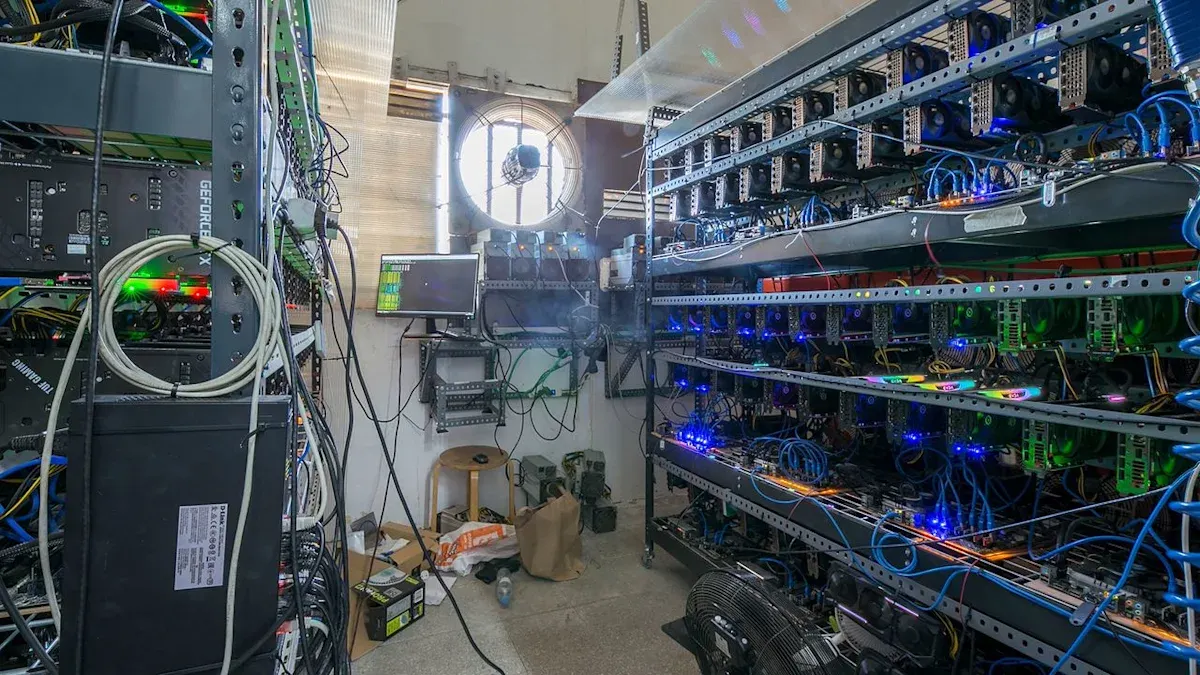 To the average regulator, computing terminology sounds like alien jargon. Words like “VRAM,” “tokens,” and “Hugging Face” (a massive open-source repository where AI developers share pre-trained software models) get conflated into a generic stew called “crypto.”
The underlying hardware physics tells a different story, one that depends on what was actually inside those chassis. No public source has yet placed a verified market valuation on the Tlaola hardware, so the number that follows is an estimate, not a confirmed finding.
300 units still leaves a wide field of possibilities.
300 enterprise-grade data-center chips, the kind nation-states use to train foundation models from scratch, would run to several million dollars, a baffling overinvestment for a rural compound with no need for that level of raw training power.
300 prosumer-grade GPUs, by contrast, price out at roughly $1 million: capable enough for serious work, cheap enough to be disposable, unremarkable enough to survive a random customs inspection. A bad actor optimizing for capability per dollar, and for not drawing attention, would choose the second option every time.
That is a bet about incentives, not a fact about the inventory. No public filing yet confirms which tier of hardware sat in that warehouse. What follows describes what the prosumer-grade reading would mean, on the working assumption that the cheaper, more logical choice was also made.
Start with the difference between a single-purpose Bitcoin miner and a general-purpose Graphics Processing Unit (GPU). Modern Bitcoin mining relies almost exclusively on Application-Specific Integrated Circuits (ASICs), chips hardwired to do one thing: compute SHA-256 hashes.
An ASIC cannot run an operating system, process text, translate audio, or host software. It is a digital pickaxe.
Using 300 general-purpose GPUs to mine Bitcoin is like hunting squirrels with a machine gun. Technically it works. The ammunition costs dwarf the value of the meat, and the weapon is absurdly over-engineered for the task.
So why deploy 300 general-purpose GPUs? Because GPUs are programmable, and their real currency is VRAM, Video Random-Access Memory.
Think of a hard drive as a filing cabinet down the hall: it holds vast amounts of information, but retrieving it takes time. VRAM is the desk directly in front of the worker; the larger the desk, the more can be laid out and analyzed at once.
A standard consumer laptop might carry 8 gigabytes of VRAM. The 300 GPUs seized in Tlaola, at the prosumer tier, represented over 7.2 terabytes of that desk space.
AI models break language, audio, and images into small units called tokens, and the more tokens a system must hold active at once the more VRAM desk it needs to lay the data out without crashing.
7.2 terabytes will not train a trillion-parameter model like GPT-4 from scratch; that takes tens of thousands of specialized data-center chips. But it is the exact sweet spot for local inference and fine-tuning: enough to download an open-source model such as Meta’s Llama 3 70B or 405B from Hugging Face, strip its safety guardrails, load it entirely into local memory, and run it in an air-gapped environment.
Then there is the power. Running 300 high-end GPUs alongside cooling exhaust fans requires hundreds of kilowatts of continuous industrial electricity, 24 hours a day, 7 days a week. At commercial rates, that would cost $20,000–$40,000 a month, a paper trail no one wants.
Benítez estimated the farms consumed roughly 200,000 pesos in electricity per day. That legitimate power cost alone would have eaten up roughly 70 percent of the value of whatever cryptocurrency the operation was ostensibly mining.
Stealing power from the dam reduced the marginal cost to zero, keeping the operation invisible. At the same time, it warmed the forest around it.
Finally, the uplinks: 8 Starlink dishes mounted along the corrugated roof.
An off-grid supercomputer is useless if it cannot reach its handlers, and plugging into local fiber or telephone lines exposes the operation to wiretaps, line cuts, and outages.
Eight dishes gave it a redundant satellite umbrella. If storm clouds blocked one, or one connection dropped, the other seven absorbed the traffic, bypassing Mexican ground infrastructure entirely.
An Intelligence Agency in a Shed?
 Put the pieces together: zero-cost hydropower, 7.2 terabytes of local VRAM, air-gapped satellite uplinks, general-purpose silicon, and you no longer have a facility that explains itself as a Bitcoin mine.
You have a general-purpose computing platform, capable of several things at once.
What follows is a set of working hypotheses, ordered by how likely each one is given how organized crime and state-aligned actors actually adopt technology: cheaply, opportunistically, rarely in the way a screenwriter would choose.
The most probable use, precisely because it is the most mundane, is bulk financial and open-source intelligence (OSINT) fusion.
Cartels and their political allies do not primarily need to shoot down drones or clone a governor’s voice. They need to know who owns what, who is related to whom, which shell company holds which land title, which prosecutor has a mortgage payment due.
A GPU cluster running local language models can ingest public records, court filings, land registries, social media activity, and leaked databases, then cross-reference names and financial ties faster than any team of human analysts.
It is the same document-processing and entity-resolution work banks and intelligence agencies already do, run instead for extortion targeting or identifying which officials are compromised.
It requires no specialized expertise and leaves no signature that distinguishes it from ordinary commercial analytics traffic. That is exactly why it is the likeliest workload of all.
A close second, and the use most directly supported by an odd detail in the record, is bulk decryption and device forensics.
Seized phones, encrypted apps, and password-protected records pose a constant hazard to any criminal organization; raids yield devices that must be cracked or triaged before their owners can be tipped off.
Modern GPUs are exceptionally good at the brute-force attacks used to break weak credentials, running the same forensic toolkits police departments use, pointed the other way.
A rural, off-grid compound with heavy compute and no formal telecom or bank ties would be a logical place to run this continuously, arms-length from the organization’s own command structure.
Decentralized Physical Infrastructure Network (DePIN) monetization was likely happening regardless of anything else, simply because it is close to free money and perfect camouflage.
Platforms like Akash Network or io.net let anyone with idle GPU capacity rent it to paying customers worldwide, settling in cryptocurrency. Idle-hour income from 300 GPUs could fund hardware upgrades on top of stolen, zero-cost electricity.
But the real value is cover: to an outside auditor inspecting the Starlink traffic, a legitimate DePIN node looks exactly like a commercial cloud-hosting client. Renting compute to strangers on the internet is a self-generating explanation for every byte sent and received.
Real-time signals intelligence (SIGINT), automated monitoring of police and military radio traffic, carries more circumstantial weight than the rest, because it would explain something otherwise unexplained: the compound was cleared before naval units arrived.
Monitoring radio traffic once required human listeners with headsets and log sheets. Open-source speech-to-text models, like OpenAI’s Whisper, can run locally across a GPU cluster and transcribe hundreds of channels at once, flagging keywords or coordinates the moment they’re spoken.
A single caught mention of a staging area could have bought the technical crew hours of warning.
This remains circumstantial; an empty compound is equally consistent with an informant, a leak, or luck. But of everything on this list, it is the capability a genuinely paranoid operator sitting on this much hardware would have the strongest incentive to build first.
Voice cloning for fraud or tactical deception is more speculative.
 Neural audio-synthesis models such as XTTS or Bark can generate a convincing synthetic voice from a 10-second sample of speech, a broadcast, or an intercepted call.
This is the same sort of technology behind “virtual kidnapping” scams that use a cloned family member’s voice to extract ransom, and impersonation campaigns aimed at officials.
It requires comparatively little compute to run once trained, which means it does not, on its own, explain why an operation would need 300 GPUs rather than a handful.
Least likely of all is autonomous drone target recognition: training computer-vision models, of the kind used in Ukraine to defeat GPS jamming, to let a drone identify and strike a target without a live signal.
It is the most cinematic possibility, and, for that reason, probably the one a reader’s mind reaches for first.
But it also has the thinnest connection to anything actually observed at Tlaola. No drone activity, no strikes, and no targeting data tied to this compound have been reported anywhere. It is included for completeness, not because the case points toward it.
The Questions the Raid Didn’t Answer
We may never have definitive proof of which, if any, of these workloads were running, because the state destroyed the evidence the moment it breached the perimeter.
In its haste to stop power theft, the Federal Electricity Commission immediately severed the line taps. VRAM cleared the instant power dropped.
Whatever had been running, whether model weights, intercept logs, phishing scripts, or nothing more than a mining application, vanished in milliseconds, along with any hope of confirming it later.
By treating the facility as a routine utility crime, law enforcement wiped its own evidence, leaving behind silent metal chassis and a closed case on property theft. No one has claimed any sort of malfeasance.
What should trouble the reader is not which answer is correct, but that nobody is investigating.
No one appears to have seriously entertained the question.
As general-purpose artificial intelligence gets lighter, cheaper, and less tied to centralized corporate data centers, the tools to build something stranger than a Bitcoin mine are within reach of transnational networks operating under corrupt political shields and stolen utilities.
So long as regulators evaluate every off-grid server farm through the narrow lens of utility theft and cryptomining, they will keep counting the basketball passes, never pausing to ask what else might be standing in plain sight.
To read articles like this every week, we invite you to become a TTPer!
|
W.T. Hale is a cybersecurity expert.
 Join the forum discussion on this post